
News by AUN News correspondent
Thursday, October 01, 2026
Global commerce entered 2026 with remarkable momentum, powered by artificial-intelligence investment and resilient Asian trade. But war, energy shocks, shipping disruptions and a new wave of protectionism are threatening to turn that strength into a much slower year.
The global trading system is facing a defining test.
After world merchandise trade expanded by 4.6% in 2025, substantially exceeding earlier expectations, the World Trade Organization’s March 2026 baseline forecast projected growth to slow to 1.9% this year, before recovering to 2.6% in 2027. Services trade is expected to prove more resilient, growing 4.8% in 2026 and 5.1% in 2027.
But the outlook is now being shaped by two forces pulling in opposite directions.
On one side is the extraordinary investment boom surrounding artificial intelligence, driving demand for semiconductors, data-transmission equipment and other digital infrastructure.
On the other is the economic shock from the Middle East conflict, including disruption around the Strait of Hormuz, higher energy prices and pressure on transport and tourism.
The WTO has described the resulting question in stark terms: will the AI boom continue to propel trade, or will the energy and geopolitical shock dominate?
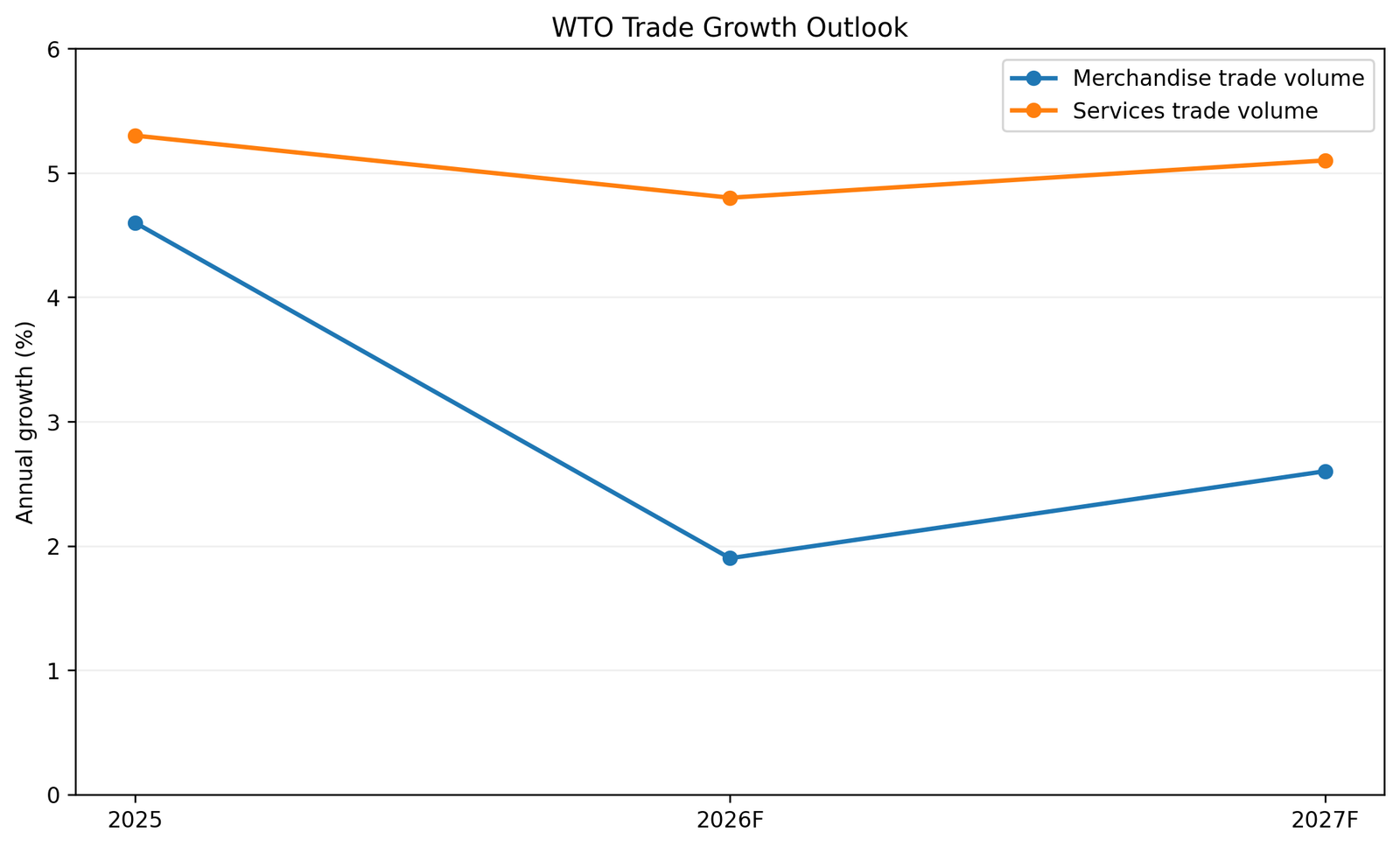
Source: WTO, March 2026 Global Trade Outlook and Statistics. 2026–2027 figures are forecasts.
2025 Delivered a Major Trade Surprise
The starting point for understanding 2026 is the unexpectedly strong performance of 2025.
World merchandise trade volume increased 4.6%, almost twice the 2.4% growth rate projected in the WTO’s October 2025 forecast. The result came despite higher tariffs and significant uncertainty surrounding trade policy.
The value of world merchandise exports reached US$26.26 trillion, an increase of 7% from 2024.
Commercial services performed even better in value terms, reaching US$9.56 trillion, up 8%. Combined goods and services trade reached approximately US$34.65 trillion on a balance-of-payments basis.
The 2025 figures therefore represented not merely another year of expansion, but evidence of considerable resilience in the global trading system.
What drove the surge?
Three forces were particularly important:
AI investment. Demand for AI-related hardware created a powerful new source of merchandise trade.
Import front-loading. Businesses accelerated some purchases ahead of expected tariff increases, particularly in the United States.
South-South commerce. Trade among developing economies remained comparatively strong, providing another source of demand as traditional trade relationships came under pressure.
AI Has Become a Major Engine of World Trade
Few developments have changed the trade outlook as quickly as artificial intelligence.
In 2025, trade in AI-enabling goods—including semiconductors, chips and data-transmission equipment—rose 21.9% year on year, reaching approximately US$4.18 trillion, up from US$3.43 trillion in 2024.
The significance goes beyond the headline value.
The WTO estimates that AI-enabling goods accounted for 42% of total global trade growth in 2025, even though they represented only about one-sixth of global trade.
That makes the AI economy one of the most important variables in the 2026 trade equation.
The demand is spreading across the entire technology supply chain—from advanced chips and semiconductor manufacturing equipment to data centres, networking equipment and electricity infrastructure.
The geographic consequences are also significant.
Asian economies remain deeply embedded in the production networks supplying these technologies, strengthening the region’s position in the next phase of global trade.
The 2026 Forecast: A Sharp Deceleration
The WTO’s March baseline projected a substantial slowdown.
| Indicator | 2025 | 2026 forecast | 2027 forecast |
|---|---|---|---|
| Merchandise trade volume | 4.6% | 1.9% | 2.6% |
| Services trade volume | 5.3% | 4.8% | 5.1% |
| Goods & services trade | 4.7% | 2.7% | — |
| World GDP | 2.9% | 2.8% | 2.8% |
Source: WTO, Global Trade Outlook and Statistics, March 2026.
AUN News Data Chart
Download the high-resolution WTO trade-growth chart
The most striking feature is the divergence between goods and services.
Merchandise trade is expected to lose more than half its 2025 growth rate in 2026, while services are forecast to remain comparatively resilient.
That matters because the global economy is becoming increasingly dependent on services linked to technology, finance, communications, professional activity and digital delivery.
The Global Economy Is Entering a Different Trade Cycle
There is another important signal in the WTO forecast.
In 2025, world trade in goods and services expanded by around 4.7%, substantially faster than global GDP growth of 2.9%.
For 2026, the WTO expects trade growth of around 2.7%, almost exactly alongside projected GDP growth of 2.8%.
This suggests that the exceptional trade intensity seen in 2025 is unlikely to continue at the same pace.
Trade is no longer providing the same powerful multiplier over global economic growth.
That does not necessarily mean the world is entering a global recession.
It means the extraordinary expansion of cross-border commerce seen last year is expected to moderate sharply.
Middle East Conflict Creates a Second Shock
The most significant downside risk comes from the Middle East.
The WTO’s March analysis estimated that sustained high oil prices associated with the conflict could reduce merchandise trade growth by 0.5 percentage points, taking the 2026 forecast from 1.9% to approximately 1.4%.
The effect extends well beyond oil.
The Strait of Hormuz is a critical artery for global energy and maritime commerce. Disruption there can increase shipping costs, insurance premiums and delivery times while forcing companies to reconsider routes and inventories.
For energy-importing economies, higher fuel costs can also suppress household and business demand.
The WTO has warned that the conflict could subtract as much as 0.7 percentage points from services trade growth, particularly through disruption to transport and international travel.
The Strait of Hormuz Has Become a Global Trade Variable
The geopolitical significance of the conflict is therefore also economic.
A disruption in a geographically concentrated maritime corridor can transmit an energy shock across continents.
The effects can move through a chain:
Conflict → shipping disruption → higher freight and insurance costs → higher energy prices → higher production costs → weaker demand → slower trade.
The WTO reported in July that the first-quarter 2026 global trade figures remained surprisingly resilient despite the conflict, but warned that the impact of disruptions around Hormuz would be more visible in subsequent data.
That distinction is crucial.
The first-quarter numbers do not necessarily tell the full story of the conflict’s annual economic consequences.
Q1 Trade Was Stronger Than Expected
There was, however, encouraging news.
WTO and UN Trade and Development estimates showed that seasonally adjusted world merchandise trade volume increased 1.9% quarter on quarter in Q1 2026 and 3.2% compared with Q1 2025.
In value terms, merchandise trade increased 2% quarter on quarter and 11% year on year.
AI-related trade was particularly powerful.
The dollar value of AI-enabling goods trade increased by more than 40% year on year during Q1 2026.
This suggests that the technology investment cycle remained strong enough to offset some of the early damage caused by the Middle East conflict.
But it also creates a new question:
How long can AI-related demand compensate for geopolitical disruption?
Asia and Africa Are Expected to Lead Import Growth
The regional outlook is uneven.
Under the WTO’s March baseline, merchandise import growth in 2026 was projected at:
- Asia: 3.3%
- Africa: 3.2%
- South America: 2.5%
- Europe: 1.3%
- Middle East: 1.0%
WTO regional import-growth forecast for 2026
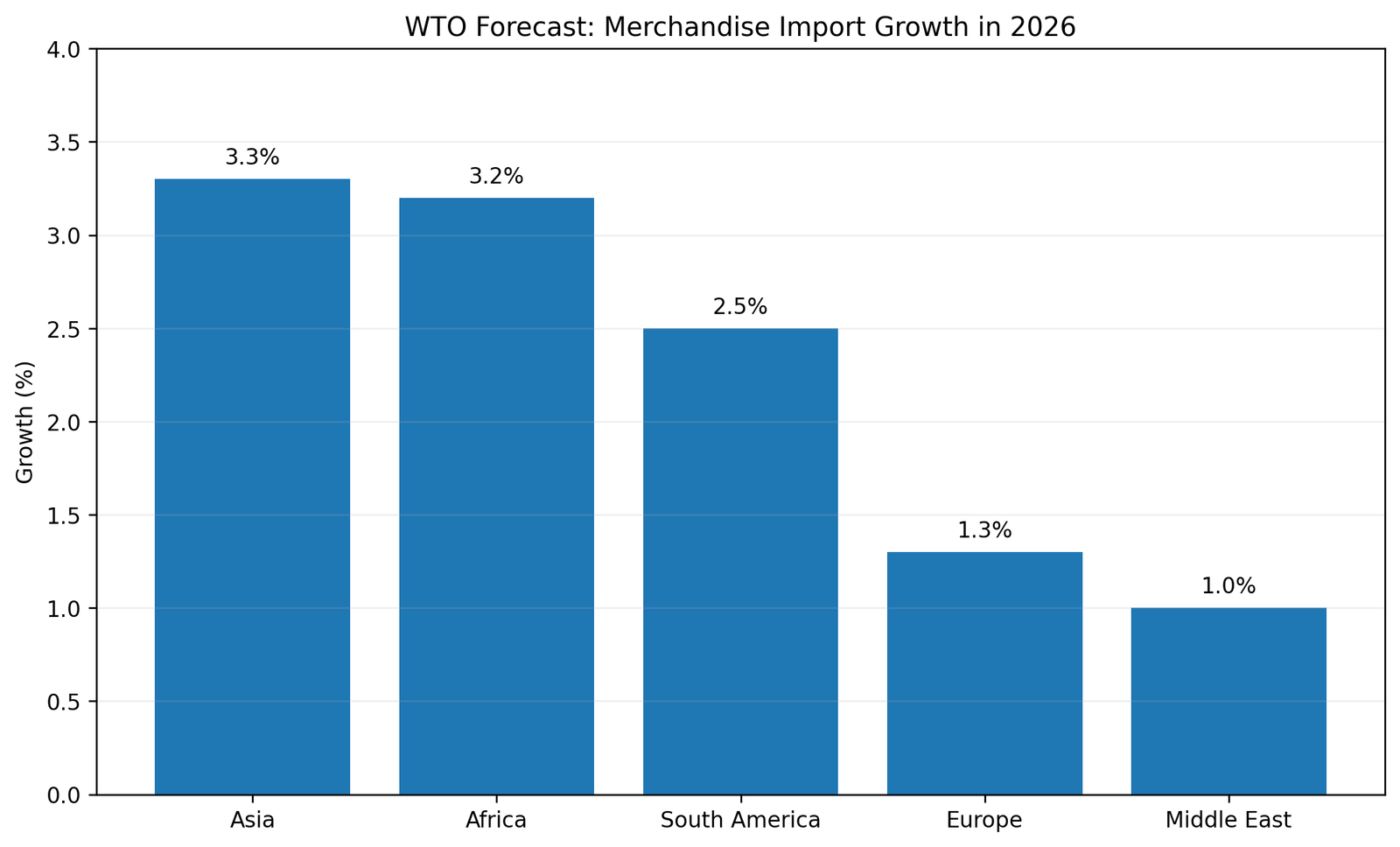
Source: WTO, March 2026 Global Trade Outlook and Statistics.
Asia’s position reflects its central role in manufacturing and technology supply chains.
Africa’s projected 3.2% growth is particularly significant given the continent’s expanding consumer markets, infrastructure investment and increasing intra-African trade.
Europe, by contrast, is expected to experience considerably slower import growth.
The Middle East has the weakest forecast among the regions listed, reflecting the immediate economic consequences of conflict and disruption.
Protectionism Is Reshaping the Trading System
The slowdown cannot be explained by war alone.
Trade policy itself is changing.
The WTO reported that the value of global goods imports affected by new tariffs and other import measures between mid-October 2024 and mid-October 2025 exceeded US$2.64 trillion—more than four times the US$611 billion recorded in the preceding monitoring period.
It was the largest coverage of new import restrictions recorded in more than 15 years of WTO monitoring.
Yet there is an important countertrend.
Governments also introduced 331 trade-facilitating measures covering an estimated US$2.09 trillion in trade during the same period—around 1.5 times the previous reporting period.
The message is therefore more complicated than simply “globalisation versus protectionism.”
Governments are simultaneously restricting some trade and facilitating other flows.
The Multilateral System Is Under Pressure—but Still Dominates
Despite the increase in tariffs and preferential arrangements, the WTO system remains deeply embedded in world commerce.
Around 72% of global merchandise trade continues to take place on most-favoured-nation terms under WTO rules. The share declined from around 80% in 2024 to roughly 72% by early 2026.
That figure is strategically important.
It demonstrates that, despite geopolitical fragmentation and trade wars, the majority of global merchandise commerce still operates within the core non-discrimination framework of the WTO.
The multilateral system has therefore weakened in relative terms without becoming irrelevant.
Supply Chains Are Being Rewritten
The current environment is also changing corporate strategy.
For decades, businesses increasingly prioritised efficiency: lower costs, just-in-time inventories and geographically concentrated production.
The new environment places greater emphasis on resilience.
Companies are increasingly considering:
- multiple suppliers;
- alternative shipping routes;
- regional manufacturing;
- strategic inventories;
- energy-security arrangements;
- digital monitoring of supply chains;
- alternative ports and logistics corridors.
This does not necessarily mean globalisation is ending.
Instead, it suggests a transition from “lowest-cost supply chains” to “risk-adjusted supply chains.”
That distinction could have profound implications for international investment.
South-South Trade Offers Another Source of Resilience
Trade among developing economies is also becoming increasingly important.
The WTO’s analysis notes that China’s exports have increasingly been redirected towards other markets, including Asia, Africa and Latin America, as trade flows between the United States and China have weakened.
This is part of a broader structural transformation.
Global trade is becoming less concentrated around a small number of traditional corridors.
Emerging economies are becoming both producers and consumers of a wider range of goods and services.
That creates opportunities for developing countries—but also intensifies competition for investment, technology and market access.
AI Could Become the Counterweight to Geopolitical Fragmentation
The unusual feature of the current trade cycle is that one of its biggest growth engines is technological rather than commodity-based.
AI infrastructure requires enormous quantities of:
- semiconductors;
- advanced computing equipment;
- networking hardware;
- data-storage systems;
- electricity infrastructure;
- cooling systems;
- specialised industrial equipment.
The resulting investment cycle crosses borders at almost every stage.
The WTO’s September 2026 World Trade Report also highlights AI as one of the structural forces reshaping the global trading system. WTO modelling suggests that AI could increase global trade substantially over the longer term if it improves productivity and reduces barriers to cross-border exchange.
That creates an important paradox.
The same technology that is accelerating trade integration is emerging at a time when geopolitics is pushing economies toward fragmentation.
A New Battle Between Efficiency and Resilience
The central policy dilemma is becoming clearer.
Highly integrated global supply chains can lower prices and improve efficiency.
But geopolitical shocks expose their vulnerabilities.
Highly regionalised supply chains may provide greater security.
But they can also increase production costs.
Governments and businesses therefore face a difficult balance between:
efficiency, resilience, affordability and strategic autonomy.
There is no single formula that works for every economy.
Developing Economies Face a Particularly Difficult Choice
For developing economies, the stakes are especially high.
Higher energy and shipping costs can quickly translate into higher food, fertiliser and manufacturing costs.
At the same time, fragmentation can make it harder for smaller economies to access global markets and technology.
But the same transformation creates opportunities.
African, Asian and Latin American economies can attract investment as companies diversify production bases and seek new consumer markets.
The challenge will be whether those economies can provide reliable infrastructure, competitive logistics, skilled workers and predictable trade policies.
What the WTO’s 2026 Numbers Really Mean
The headline forecast of 1.9% merchandise trade growth should therefore not be interpreted as a collapse in globalisation.
It is better understood as a warning that the exceptional momentum of 2025 is unlikely to continue.
There are simultaneously several competing forces:
| Force | Direction of pressure |
|---|---|
| AI infrastructure investment | Positive |
| Semiconductor demand | Positive |
| Asian manufacturing | Positive |
| South-South trade | Positive |
| Middle East conflict | Negative |
| Higher energy prices | Negative |
| Shipping disruption | Negative |
| Tariff escalation | Negative |
| Trade-policy uncertainty | Negative |
| Services and digital trade | Positive / resilient |
The final outcome will depend on which forces prove stronger over the remainder of the year.
The Bigger Question: What Kind of Globalisation Comes Next?
The WTO’s newly published World Trade Report 2026 argues that the multilateral trading system is at a critical juncture after eight decades of expansion. The report warns that a breakdown of multilateral cooperation could impose significant economic costs. WTO modelling estimates that a highly fragmented world economy could reduce global GDP by around 5.1%, while a world in which the WTO system is replaced entirely by a network of free-trade agreements could see an even larger reduction.
The alternative is not simply a return to the old system.
Technology, climate policy, national-security concerns and geopolitical competition have fundamentally changed the environment in which international trade operates.
The challenge is to adapt the rules without destroying the predictability that made global commerce possible in the first place.
The Road Ahead
The global economy enters the final months of 2026 caught between two very different forces.
AI is connecting markets at extraordinary speed.
Geopolitics is pulling some of those markets apart.
The WTO’s March forecast put merchandise trade growth at 1.9%, with a potential downside to 1.4% if energy prices remain elevated because of the Middle East conflict. At the same time, sustained AI-related investment could add roughly 0.5 percentage points to growth.
The first-quarter data show that AI demand can, at least temporarily, overpower some geopolitical shocks.
But the longer the conflict persists, the harder that balancing act becomes.
For governments, the immediate priorities are clear: preserve open trade wherever possible, diversify vulnerable supply chains, protect access to energy and food, and prevent temporary trade restrictions from becoming permanent fragmentation.
For companies, resilience is becoming as important as efficiency.
And for the WTO, the challenge is larger still.
It must demonstrate that an international trading system created in the 20th century can remain relevant in an economy increasingly shaped by artificial intelligence, strategic competition, climate pressures and geopolitical fragmentation.
The future of globalisation may not be decided by one tariff, one war or one technology.
It will be decided by how these forces interact.
In 2026, the world’s trading system is discovering that the biggest economic question is no longer simply how much the world trades—but how resiliently, securely and cooperatively it can continue to trade.
AUN News | Global Trade Data Snapshot
| Indicator | Latest figure |
|---|---|
| World merchandise trade growth, 2025 | 4.6% |
| WTO baseline forecast, 2026 | 1.9% |
| WTO forecast, 2027 | 2.6% |
| Services trade growth, 2025 | 5.3% |
| Services trade forecast, 2026 | 4.8% |
| World merchandise trade value, 2025 | US$26.26 trillion |
| Services trade value, 2025 | US$9.56 trillion |
| AI-enabling goods trade, 2025 | US$4.18 trillion |
| AI-enabling goods growth | 21.9% |
| Share of 2025 global trade growth from AI-enabling goods | 42% |
| MFN share of world merchandise trade | 72% |
| Potential trade-growth hit from sustained high oil prices | −0.5 percentage points |
| Q1 2026 merchandise trade growth, year on year | 3.2% |
| Q1 2026 AI-enabling goods value growth | More than 40% |
Sources: World Trade Organization, Global Trade Outlook and Statistics, March 2026; WTO 2026 trade statistics and September 2026 Goods Trade Barometer. Forecast figures should not be confused with subsequently observed trade data.

