
News by AUN News correspondent
Saturday, October 03, 2026
A prolonged democratic recession is entering a more dangerous phase, with freedom of expression, press freedom, rule of law and access to justice under sustained pressure across much of the world.
For two decades, the global democratic landscape has been moving in the wrong direction.
The latest Freedom in the World 2026 assessment from Freedom House says global freedom declined for the 20th consecutive year in 2025, with political rights and civil liberties deteriorating in 54 countries while only 35 registered improvements. Just 21% of the world’s population now lives in countries classified as “Free”, compared with 46% two decades ago.
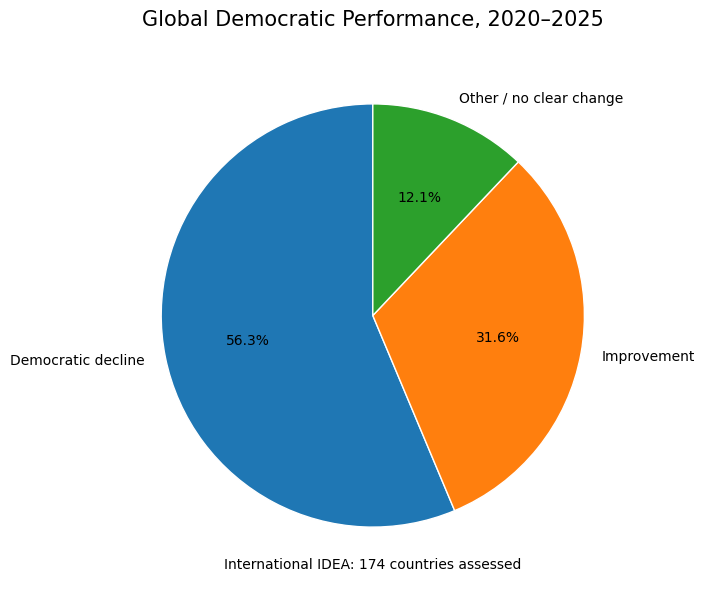
International IDEA’s newly released Global State of Democracy 2026: Democracy in an Age of Conflict reaches a similarly troubling conclusion. Its data show that 98 of 174 countries—57%—experienced deterioration in at least one democratic indicator between 2020 and 2025, while only 55 countries, or 32%, improved.
The numbers point to something deeper than a succession of isolated political crises.
They suggest a structural weakening of some of the institutions and freedoms that make democratic government meaningful.
A Two-Decade Democratic Recession
The latest Freedom House assessment marks a grim milestone.
Global freedom has now declined every year since 2006.
The deterioration has taken different forms in different countries: military coups, attacks on independent institutions, political violence, restrictions on civil society, pressure on journalists, weakened judicial safeguards and efforts by executives to concentrate power.
Freedom House recorded deterioration in political rights and civil liberties in 54 countries during 2025, compared with improvements in 35. The result is a global political landscape in which authoritarian and hybrid systems have gained greater weight while established democracies have themselves experienced institutional stress.
The significance of the 20-year trend lies not only in the number of countries affected.
It is the persistence of the decline.
A temporary political crisis can be reversed. A two-decade deterioration suggests that the international system is confronting a much more entrenched challenge.
International IDEA Finds an 11-Year Pattern of Democratic Decline
International IDEA’s findings reinforce the warning, while using a different methodology.
Its Global State of Democracy Indices assess 174 countries across four broad dimensions: Representation, Rights, Rule of Law and Participation, using 154 indicators drawn from more than 22 official and international datasets.
The 2026 report finds that 57% of assessed countries declined in at least one democratic indicator between 2020 and 2025, compared with 32% that improved.
It is the 11th consecutive year in which more countries declined than improved.
That does not mean every democratic institution is deteriorating everywhere.
In fact, International IDEA reports considerable stability across much of its dataset. But that stability is not necessarily reassuring: many countries remain in the middle range of democratic performance, where institutions exist but may lack the strength to withstand political shocks.
This “messy middle” is becoming one of the report’s central concerns.
The Most Dangerous Ground May Be Between Democracy and Autocracy
One of the most important findings from International IDEA is that democratic decline is closely connected to the risk of violent conflict.
Countries that possess some democratic mechanisms—such as elections and political parties—but lack effective political competition, institutional checks and enforceable rights can be particularly vulnerable.
International IDEA describes these systems as being in an “in-between” condition between consolidated democracy and consolidated autocracy.
Historically, such environments have been associated with elevated risks of both domestic and interstate conflict.
The report does not argue that every democratic decline automatically causes war.
The relationship is more complicated.
But the evidence indicates that when institutions become too weak to peacefully manage political competition, while governments also lack the legitimacy or capacity associated with stable democratic systems, the space for violence can expand.
That matters at a time when the global conflict environment is already deteriorating.
International IDEA reports that 2025 saw 65 state-based conflicts—the highest number recorded since the Uppsala Conflict Data Program’s series began in 1946—including eight interstate conflicts, also a record in that dataset.
Freedom of Expression Is Becoming an Early Warning Signal
Among the democratic freedoms under pressure, freedom of expression occupies a particularly important position.
When citizens cannot criticise governments freely, when journalists cannot investigate powerful interests, or when opposition groups cannot organise without fear, democratic accountability becomes increasingly difficult.
International IDEA identifies Freedom of Expression and Freedom of the Press among the areas experiencing some of the most significant recent declines.
The significance extends beyond politics.
Freedom of expression allows societies to expose corruption, challenge government decisions, debate public policy and identify institutional failures before they become crises.
Once those channels begin to close, governments can become increasingly insulated from public scrutiny.
The Press Is Under Pressure From Governments—and Powerful Non-State Actors
UNESCO’s 2026 assessment of global media trends adds another layer to the picture.
Its latest findings show a 10% decline in the global freedom-of-expression index since 2012, while self-censorship among media professionals has reached 63%. UNESCO also reports a 48% increase in control over media outlets by governments and powerful actors, including newspapers, radio stations and digital platforms.
The changing information environment is therefore not simply a traditional censorship story.
The pressure increasingly comes through ownership, political influence, economic concentration, legal threats, digital manipulation and online harassment.
For journalists, the consequences can be physical as well as professional.
UNESCO recorded 310 journalists killed between January 2022 and September 2025, including 24 women. Of those deaths, 162 occurred while journalists were covering armed conflicts.
Impunity Makes the Problem Worse
Violence against journalists becomes particularly damaging to democracy when perpetrators believe they will not be held accountable.
UNESCO reports that 85% of journalist killings remain unpunished.
That figure represents more than a failure of criminal justice.
It sends a wider signal about the credibility of the rule of law.
If journalists can be attacked without effective investigation, the threat extends beyond the individual reporter. Other journalists may stop investigating sensitive issues. Editors may become more cautious. Sources may become reluctant to speak.
Eventually, self-censorship can replace formal censorship.
That is precisely why UNESCO’s finding that self-censorship affects 63% of media professionals is so significant.
Women Journalists Face a Particularly Difficult Environment
The digital transformation of journalism has created new opportunities for reporting—but also new avenues for intimidation.
Women journalists in particular face sustained online abuse, threats and coordinated harassment.
The combination of online attacks and offline security risks can create a chilling effect that extends beyond individual journalists.
For democratic societies, the issue is therefore not merely workplace safety.
It concerns whether women can participate equally in public debate and whether media institutions can retain diverse voices when harassment becomes a professional cost.
Rule of Law Is Emerging as Democracy’s Weakest Link
International IDEA identifies Rule of Law as the weakest of its four broad democratic categories in 2025.
Its assessment places 71 countries—41% of those assessed—in the low-performing range for Rule of Law.
More significantly, Rule of Law experienced the largest number of category-level declines in 2025, with 29 countries registering deterioration.
The category encompasses judicial independence, absence of corruption, predictable enforcement, and personal integrity and security.
These are not technical legal questions.
They determine whether citizens can reasonably expect the law to apply consistently—and whether governments themselves are constrained by institutions capable of checking executive power.
Elections Alone Are Not Enough
The global debate over democracy often focuses heavily on elections.
Elections remain indispensable, but International IDEA’s findings underline why elections alone cannot define democratic health.
A country can hold regular elections while simultaneously experiencing declining press freedom, weakened courts, restricted civic space and growing executive dominance.
The result may be a political system that retains the appearance of democratic procedure while losing many of the institutional safeguards that make political competition meaningful.
This is one reason International IDEA assesses democracy across multiple dimensions rather than treating elections as the sole measure of democratic performance.
The Information Battlefield Is Changing
The democratic challenge is also becoming increasingly technological.
Artificial intelligence, social media, algorithmic amplification and digitally coordinated influence campaigns are transforming how citizens receive political information.
UNESCO’s 2026 media assessment identifies information manipulation and interference—including those involving AI—as part of the changing threat environment for journalism and public debate.
The result is a paradox.
Technology has dramatically expanded the number of people who can publish, communicate and organise.
But the same technology can also be used to flood public debate with fabricated information, intimidate critics, manipulate political narratives and make it harder for citizens to distinguish reliable information from coordinated influence.
The future of democracy will therefore depend partly on whether societies can protect free expression without allowing information ecosystems to become so polluted that citizens lose confidence in what they see and hear.
Democracy and Conflict Are Becoming Increasingly Intertwined
The implications extend far beyond civil liberties.
International IDEA’s 2026 report places democratic decline alongside the resurgence of violent conflict.
Its analysis finds that the deterioration of democratic institutions can create conditions associated with greater conflict risk, particularly in countries trapped between democracy and autocracy.
The relationship is not automatic.
But weakened institutions reduce the number of peaceful mechanisms available for resolving disputes.
When elections become contested, courts lose independence, media outlets are constrained and opposition groups are marginalised, political competition can become increasingly difficult to manage without confrontation.
This is why democracy is increasingly being discussed not only as a human-rights issue but also as a peace and security issue.
A World Becoming More Fragmented
International IDEA describes the present international environment as one of “Great Fragmentation”, characterised by weakening alliances, geopolitical uncertainty, rising insecurity and declining confidence in multilateral institutions.
This fragmentation creates an additional problem.
Democratic governments that once treated democracy promotion as part of a common international agenda are increasingly preoccupied with domestic political pressures and strategic competition.
Meanwhile, authoritarian governments can exploit divisions among democratic states.
The result is a more competitive global environment in which democratic norms have fewer automatic defenders.
The Young Are Becoming a Critical Democratic Constituency
There is another dimension that cannot be ignored: younger generations.
Young people are increasingly politically active through digital platforms, protest movements, civic campaigns and grassroots organisations.
At the same time, dissatisfaction with political institutions can be particularly strong among younger citizens when democracy appears unable to deliver economic security, fairness or meaningful political influence.
Freedom House has consequently called for more strategic engagement with younger generations and greater opportunities for meaningful political participation.
For democratic institutions, this represents both a challenge and an opportunity.
Young citizens who become disengaged can deepen democratic decline.
Young citizens who become organised participants can become one of democracy’s strongest sources of renewal.
The Democratic Picture Is Not Hopeless
The headline figures are severe, but they do not show a world in which democracy has simply disappeared.
International IDEA’s report also documents resilience, recovery and cases of democratic improvement.
The organisation stresses that democratic performance is not fixed and that civil society and public participation can play an important role in reversing negative trajectories.
Freedom House similarly argues that the current period of decline does not mean democratic change is impossible. Its 2026 assessment calls for stronger coordination among democracies, improved democracy assistance and greater engagement with younger generations.
The lesson is therefore not that democratic decline is inevitable.
It is that democratic institutions require active protection.
What Governments Need to Protect
The evidence emerging from Freedom House, International IDEA and UNESCO points toward several priorities.
1. Defend independent institutions
Courts, election commissions, legislatures and oversight institutions need sufficient independence to restrain executive power.
2. Protect journalists
Attacks on journalists must be investigated and prosecuted. Impunity undermines not only press freedom but public confidence in the rule of law.
3. Keep civic space open
Civil-society organisations, opposition parties, researchers, activists and community groups require meaningful space to organise and participate.
4. Protect freedom of expression online and offline
Governments need to distinguish legitimate regulation from censorship and ensure that digital governance does not become a mechanism for suppressing legitimate political speech.
5. Make young people participants—not spectators
Democratic renewal requires meaningful opportunities for younger citizens to vote, organise, deliberate and influence policy.
6. Treat democracy as a peace investment
The relationship between democratic institutions and conflict risk means democracy support should increasingly be considered part of broader international peace and security strategies. International IDEA explicitly recommends integrating democracy support into national security approaches.
The Numbers Tell a Story the World Cannot Ignore
The statistics from the three major assessments are different because the institutions measure different things.
But their direction is remarkably consistent.
Freedom House: global freedom has declined for 20 consecutive years.
International IDEA: 57% of assessed countries recorded deterioration in at least one democratic indicator between 2020 and 2025, continuing an 11-year pattern in which declines outnumber improvements.
UNESCO: the global freedom-of-expression index has fallen 10% since 2012, while self-censorship among media professionals has reached 63%.
Conflict: International IDEA reports that 65 state-based conflicts occurred in 2025, the highest number in the Uppsala Conflict Data Program’s historical series.
Together, the indicators describe a world in which democratic institutions are facing pressure at the same time as geopolitical fragmentation and violent conflict are increasing.
A Critical Test for the Next Decade
The central question is no longer whether democracy is under pressure.
The evidence makes that difficult to dispute.
The more important question is whether democratic societies can reverse institutional erosion before it becomes entrenched.
The answer will depend on courts that can remain independent, journalists who can investigate without fear, citizens who can criticise governments without retaliation, elections that retain credibility, legislatures capable of exercising oversight, and civil societies that remain free to organise.
It will also depend on whether democratic governments are prepared to defend those principles when doing so is politically inconvenient.
The warning from Stockholm, Washington and the international media community is therefore not simply about the decline of democracy as a political system.
It is about the weakening of the institutional safeguards that allow societies to resolve disagreement without violence.
For two decades, the global freedom curve has been moving downward.
The defining democratic challenge of the coming decade will be whether that curve can finally be turned around.
AUN News Data Desk
Global Democratic Performance, 2020–2025
The accompanying pie chart is based on International IDEA’s assessment of 174 countries: 98 recorded a decline in at least one democratic indicator, 55 improved, and 21 fell into the remaining category.
Download the high-resolution pie chart
Key indicators
| Indicator | Latest finding |
|---|---|
| Consecutive years of global freedom decline | 20 years |
| Countries with deterioration, Freedom House 2026 | 54 |
| Countries with improvement, Freedom House 2026 | 35 |
| World population living in “Free” countries | 21% |
| Countries declining in ≥1 IDEA indicator | 98 / 174 |
| Countries improving in ≥1 IDEA indicator | 55 / 174 |
| Consecutive years declines exceeded improvements | 11 years |
| Decline in global freedom-of-expression index since 2012 | 10% |
| Media professionals reporting self-censorship | 63% |
| Increase in control/restriction of media | 48% |
| Journalists killed, Jan. 2022–Sept. 2025 | 310 |
| Journalists killed covering armed conflicts | 162 |
| Journalist killings remaining unpunished | 85% |
| State-based conflicts in 2025 | 65 |
Sources: Freedom House, International IDEA and UNESCO. The indicators use different methodologies and reference periods and should not be treated as a single composite democracy index.

