News by AUN News correspondent
Tuesday, August 18, 2026
Education has expanded dramatically since 2000. But the latest UNESCO assessment shows that access is now stagnating, 273 million children and young people remain outside school, and the world is moving too slowly to achieve SDG 4 by 2030.
The global education story in 2026 is one of striking progress—and an increasingly difficult race against time.
More children are entering school than ever before. Completion rates have risen substantially over the past quarter-century, while participation in pre-primary and post-secondary education has expanded.
Yet the number of children, adolescents and young people outside the education system has moved in the opposite direction.
According to UNESCO’s 2026 Global Education Monitoring (GEM) Report, an estimated 273 million children, adolescents and youth were out of school in 2024. The figure has risen for seven consecutive years and represents approximately one in six people in the relevant age groups worldwide.
The findings put renewed pressure on governments to accelerate progress towards Sustainable Development Goal 4, which calls for inclusive and equitable quality education and lifelong learning opportunities for all by 2030.


7
A paradox at the heart of global education
The latest figures reveal a striking contradiction.
The world has expanded education access on a massive scale since the turn of the century. UNESCO estimates that 327 million more students were enrolled in primary and secondary education in 2024 than in 2000, an increase of 30%.
Pre-primary enrolment increased by 45%, while post-secondary enrolment increased by 161% over the same period. There were approximately 1.4 billion students enrolled in school globally in 2024.
Yet this expansion has not been sufficient to deliver universal access.
After the global out-of-school population declined by 33% between 2000 and 2015, it began rising again. By 2024, it had reached 273 million—3% higher than in 2015. UNESCO says the increase has occurred for seven consecutive years.
The result is an uncomfortable reality: more people are receiving education, while millions remain completely excluded from it.
The completion story offers a measure of progress
The picture is not uniformly negative.
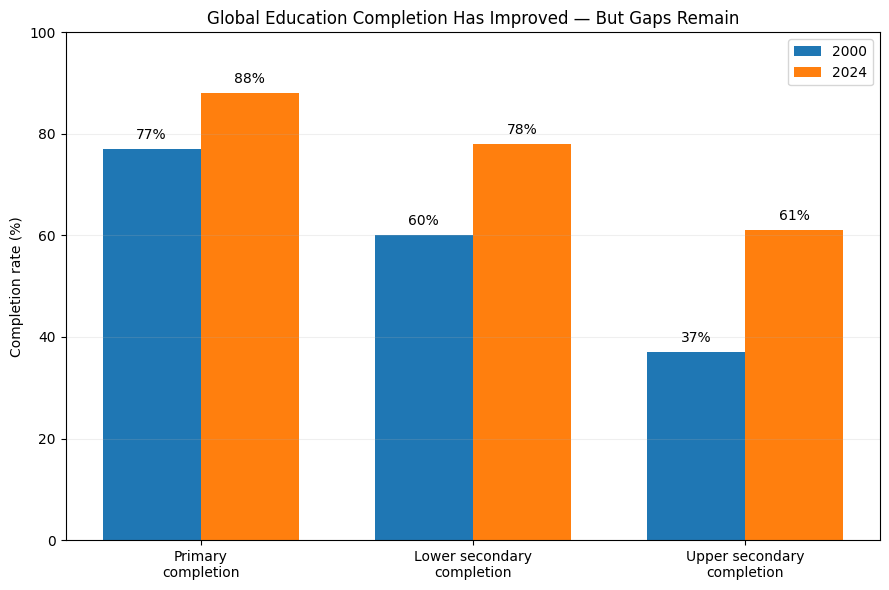
Global completion rates have increased considerably since 2000.
According to UNESCO’s 2026 assessment, primary completion increased from 77% to 88%, lower-secondary completion from 60% to 78%, and upper-secondary completion from 37% to 61%.
Global education completion, 2000 vs. 2024
Download the high-resolution chart
The figures demonstrate why UNESCO’s assessment is more nuanced than simply describing the world as failing on education.
The international community has made substantial gains.
The problem is that the pace of those gains is insufficient to meet the ambitions established for 2030.
UNESCO describes the central challenge as one in which global education ambitions have repeatedly expanded faster than education systems themselves.
The children who remain outside the system are increasingly difficult to reach
The remaining education gap is not evenly distributed.
Conflict, poverty, displacement, geography, disability and other forms of inequality can make access substantially more difficult. UNESCO’s 2026 report highlights the importance of examining differences by sex, location, wealth and disability, rather than relying only on global averages.
The data also contain an important warning about conflict.
UNESCO estimates that the 273 million figure may be undercounted by at least 13 million if supplementary humanitarian information is used to correct data gaps in the ten countries most affected by conflict.
That means the headline figure itself should be treated as an estimate rather than an exhaustive count.
The learning crisis is just as important as school access
Getting children through the school gate is only one part of SDG 4.
The quality of what happens inside the classroom remains a major concern.
The latest comparable global data show that only 58% of students achieved minimum proficiency in reading at the end of primary education, while just 44% achieved minimum proficiency in mathematics.
That creates a second dimension to the education crisis.
A child may technically be enrolled and still leave primary school without mastering the foundational skills needed for further education.
UNESCO’s assessment therefore distinguishes between participation, completion and learning—three different dimensions that cannot be treated as interchangeable.
Education financing is moving further away from international benchmarks
Money is another critical part of the equation.
The 2026 SDG 4 Scorecard reports that countries’ public education spending in 2024 was further from the twin international benchmarks of 4% of GDP and 15% of total public expenditure than it was in 2015.
The financing picture is complicated further by falling international aid.
UNESCO’s latest education-finance data show that between 2023 and 2024, aid to basic education fell by 15%, twice the rate of decline in aid to education overall. UNESCO now estimates that aid to education could decline by around 30% between 2023 and 2027 under current trends.
The organisation estimates an annual financing gap of approximately $97 billion for countries seeking to reach their education targets by 2030.
Countries are setting their own targets—but implementation remains uneven
One of the major developments in the SDG 4 monitoring architecture has been the introduction of national benchmarks.
Rather than measuring every country against a single identical trajectory, UNESCO and the UNESCO Institute for Statistics have encouraged governments to establish 2025 and 2030 national benchmarks for eight SDG 4 indicators.
The 2026 Scorecard reports that 83% of countries have submitted national targets, or agreed to be bound by a regional target, for at least one indicator.
Countries have generally made greater progress in primary and lower-secondary participation and completion than in upper-secondary education.
But major data gaps remain, particularly concerning:
- minimum learning proficiency;
- school internet connectivity;
- trained teachers;
- inequalities by wealth and location.
These gaps make it harder to determine whether countries are genuinely on course or whether incomplete data are obscuring the situation.
The digital divide remains an education divide
Technology has expanded educational opportunities in many countries, but UNESCO cautions that digital access has not been distributed equally.
Schools in poorer countries continue to face major infrastructure constraints.
In low-income countries in 2024, UNESCO reports that only 40% of primary schools had handwashing facilities, 52% had drinking water and 28% had electricity.
The figures demonstrate that the education challenge is not simply about providing laptops, internet connections or digital learning platforms.
For millions of children, the more basic questions remain whether there is a functioning school, electricity, safe drinking water, trained teachers and a secure environment in which to learn.
Teachers remain central to the equation
The quality of education ultimately depends heavily on the people delivering it.
UNESCO’s 2026 monitoring shows that globally around 90% of primary teachers meet national academic requirements, while approximately 82% meet professional requirements. The report also identifies declines in teacher qualifications in both low- and high-income settings.
This places teacher preparation and professional development at the centre of the SDG 4 challenge.
The issue is not simply how many teachers are employed, but whether education systems can recruit, train, retain and support teachers capable of delivering effective learning.
Sub-Saharan Africa faces particularly severe learning and access gaps
The global averages conceal substantial regional differences.
UNESCO’s 2026 learning assessment reports that only one in five children in sub-Saharan Africa who reach the end of primary school achieves minimum proficiency in the required learning standard.
The region also faces the effects of conflict, poverty, infrastructure shortages, teacher constraints and demographic growth.
This creates a particularly difficult policy equation: education systems must expand rapidly while simultaneously improving quality and reaching populations that are hardest to serve.
But the data also show that progress is possible
The UNESCO report does not present the global situation as irreversible.
Some countries have achieved substantial reductions in out-of-school rates since 2000.
UNESCO identifies Madagascar and Togo among countries that have reduced out-of-school rates for children by at least 80%, while Morocco and Viet Nam have recorded major reductions among adolescents, and Georgia and Türkiye among youth.
These examples matter because they demonstrate that education trajectories are not predetermined.
Policy choices, financing arrangements, social conditions and institutional capacity can alter the pace of progress.
The 2030 deadline is becoming a governance test
The education challenge now extends beyond the education ministry.
SDG 4 intersects with poverty reduction, gender equality, employment, public health, digital inclusion, migration, peace and social cohesion.
Children who remain outside school are more exposed to a range of social and economic disadvantages, while weak learning outcomes can constrain future employment and productivity.
This makes education one of the most interconnected components of the Sustainable Development Goals.
UNESCO’s Countdown to 2030 framing reflects the urgency: the organisation says that, at current rates, a new child would need to enter education approximately every two seconds for the world to remain on track toward its national 2030 education targets.
What governments are being asked to do
The evidence points toward several areas requiring sustained policy attention.
1. Protect and improve public education financing
Governments face pressure to maintain education expenditure despite competing demands from health, security, debt servicing and other sectors. UNESCO’s monitoring indicates that the international spending benchmarks remain important reference points.
2. Prioritise the hardest-to-reach children
Global averages can hide severe inequalities. Education planning increasingly needs to identify children affected by poverty, displacement, disability, geography and conflict.
3. Shift attention from enrolment to learning
Enrolment statistics alone cannot establish whether an education system is succeeding. Foundational literacy and numeracy need to remain central measures of progress.
4. Strengthen teachers
Recruitment, professional preparation, working conditions and continuing development are fundamental to sustainable improvements in learning.
5. Close the data gaps
Governments need reliable information on attendance, completion, learning, teacher qualifications, connectivity and inequalities. Without credible data, policy targets can become disconnected from reality.
Four years to turn expansion into universal access
The 2026 evidence presents a complicated picture.
The world has 1.4 billion students in school. Hundreds of millions more children have gained access since 2000. Completion rates have improved dramatically. Tertiary education has expanded on an unprecedented scale.
At the same time, 273 million children, adolescents and youth remain outside education, and the number has risen for seven consecutive years.
The central challenge for the remaining years to 2030 is therefore not simply to expand education.
It is to accelerate expansion while improving quality, equity, financing and learning outcomes at the same time.
That is a considerably harder task.
The latest UNESCO assessment makes clear that the world has not run out of evidence that education systems can improve. It has run short of time to scale that progress to everyone.
The countdown to 2030 is no longer an abstract deadline. For 273 million children and young people, it represents the distance between being inside the education system—and being left outside it.
AUN News | Data Snapshot
| Indicator | Latest figure |
|---|---|
| Children, adolescents & youth out of school | 273 million (2024) |
| Increase in out-of-school population since 2015 | 3% |
| Consecutive years of increase | 7 |
| Students enrolled globally | 1.4 billion (2024) |
| Additional primary & secondary students since 2000 | 327 million |
| Primary completion | 88% |
| Lower-secondary completion | 78% |
| Upper-secondary completion | 61% |
| Primary reading proficiency | 58% |
| Primary mathematics proficiency | 44% |
| Countries with national SDG 4 targets | 83% |
| Estimated annual education financing gap | $97 billion |
Sources: UNESCO Global Education Monitoring Report 2026; UNESCO Institute for Statistics; UN SDG reporting. Figures refer to the latest year available for each indicator and are therefore not all from the same reference year