
Global Forum Raises Alarm
The United Nations General Assembly has raised a powerful and urgent alarm over the fate of Ukrainian children taken from territories under Russian occupation. In a move reflecting widespread international concern, member states pressed Russia to immediately ensure the safe return of every child reportedly transferred across the border.
Violation of International Norms
The Assembly emphasized that removing children from occupied regions without consent is not only a humanitarian crisis but also a direct breach of international law. Such actions, delegates stressed, undermine fundamental protections guaranteed to civilians during conflict, especially minors who are considered among the most vulnerable.
Focus on Legal and Moral Responsibility
By labeling these transfers as clear violations, the General Assembly underscored the dual responsibility—legal and moral—that Russia holds in this situation. Countries from different regions echoed that forcibly relocating children threatens their identity, security, and long-term well-being, compounding the trauma of war.
A Demand Echoing Worldwide
The call from the UN carries weight because it reflects a growing, unified global voice. Nations backing the resolution argued that international norms cannot be selectively followed, and that safeguarding children must remain a universal priority, regardless of geopolitical tensions.
Overwhelming Majority Backs Resolution
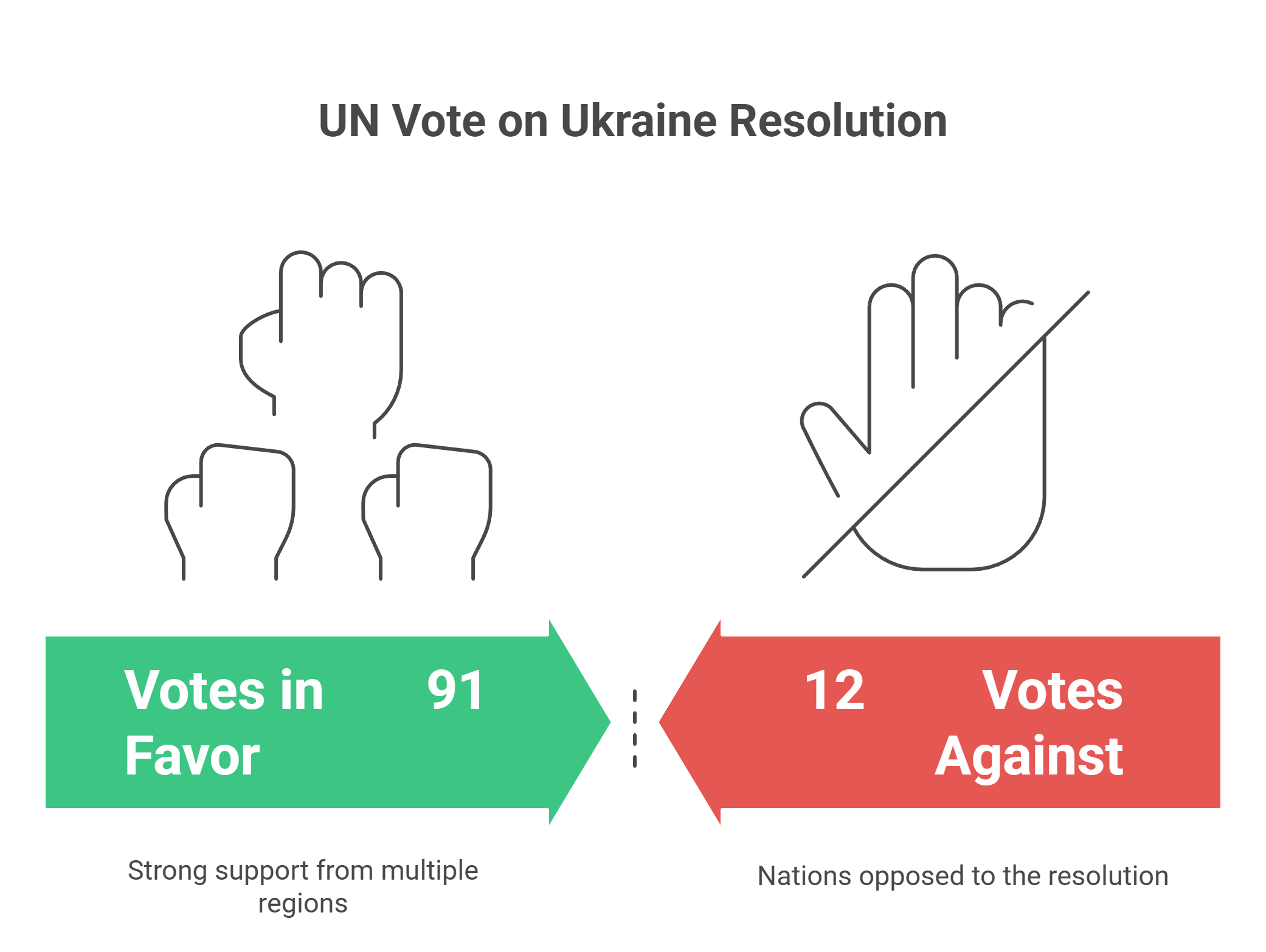
During the Eleventh Emergency Special Session on the Aggression against Ukraine, UN member states cast their votes in a tense and closely watched ballot. The resolution secured 91 votes in favor, a strong show of support from countries across multiple regions. Only 12 nations opposed, while 57 abstained, revealing not indifference but the deep geopolitical pressures shaping the debate.
The sizeable majority signaled a rising tide of global concern over the situation of Ukrainian children who have been separated from their families since the early months of the conflict. For many delegates, the vote was not just about diplomacy—it was about drawing a firm line against actions that threaten the safety, identity, and future of thousands of minors. The broad support demonstrated that, despite divisions on other aspects of the war, the international community is increasingly united in demanding urgent protection and accountability for Ukraine’s most vulnerable.
International Law at the Core of the Debate
The resolution firmly underscores that the forced movement of civilians—including children—from an occupied territory to the land of an occupying power stands in direct violation of international legal standards. These protections, rooted in the Geneva Conventions and long upheld by the global community, exist to prevent exactly the kind of displacement and vulnerability that war now threatens to impose on Ukrainian minors.
During the debate, UN member states expressed deep unease over the far-reaching consequences of such transfers. Delegates warned that these actions do not merely relocate children—they disrupt their emotional security, sever family networks, and place them at risk of losing their cultural identity. Concerns mounted that altering a child’s name, language, or citizenship could leave psychological scars long after the conflict ends. For many nations, this was not just a legal issue but a humanitarian red line, highlighting the urgent need to protect children from becoming collateral victims of geopolitical aggression.
Concerns Over Fast-Tracked Russian Citizenship
Delegates voiced strong objections to a series of laws introduced by Russia since 2022 that drastically ease the path for Ukrainian children—particularly orphans, children without parental care, and unaccompanied minors—to receive Russian citizenship. Many speakers argued that these policies, enacted during an ongoing conflict, are far from administrative formalities; instead, they represent deliberate attempts to reshape the identity and status of vulnerable children without proper oversight or consent.
The General Assembly cautioned that such measures go beyond mere documentation. By enabling rapid changes in citizenship, authorities risk erasing the legal and cultural identities that link these children to Ukraine. Delegates warned that fast-tracked citizenship can act as a gateway to forced adoptions, shifts in legal guardianship, and placements in Russian foster families—steps that not only remove children from their homeland but also sever their ties to language, heritage, and community. For many nations, the concern lay in the irreversible nature of these actions, raising fears that children could lose their rightful place in Ukrainian society long after the conflict ends.
Indoctrination and Family Separation Highlighted
The resolution expressed deep alarm over reports that once Ukrainian children are transferred into Russia, many undergo programs aimed at reshaping their beliefs, identities, and sense of belonging. Delegates cited accounts of children being placed in institutions where they are exposed to narratives that glorify the occupying power while diminishing or distorting their Ukrainian heritage. Such re-education efforts, they argued, go far beyond humanitarian care and veer into the realm of ideological conditioning.
Equally troubling were claims that children’s communication with their families and legal guardians has been restricted or cut off entirely. Several member states warned that preventing contact is not simply an administrative obstacle but a deliberate strategy that isolates children from the emotional anchors of their lives. Delegates described these actions as attempts to sever cultural, linguistic, and familial ties—creating a rupture that could follow these children for decades.
For many nations, these practices represent one of the gravest dangers highlighted in the session: the possibility that an entire generation of Ukrainian children could grow up distanced from their origins, disconnected from their families, and stripped of the cultural identity that shapes their sense of self.
Call for Immediate Action and Access
The General Assembly issued one of its strongest appeals yet, urging Russia to immediately halt all ongoing transfers of Ukrainian children and to ensure their safe, unconditional return to families or legitimate guardians. Delegates stressed that every passing day deepens the uncertainty surrounding the children’s welfare, making swift action not just a diplomatic request but a moral imperative.
Beyond demanding the return of the minors, the resolution called on Secretary-General António Guterres to take a direct role in the effort. Member states asked him to engage with Moscow at the highest levels to secure unrestricted access for UN bodies and international humanitarian organizations. Such access, they emphasized, is essential to determine the exact locations, conditions, and safety of the children—information that remains incomplete and often contested.
Delegates argued that transparency is the first step toward accountability. Without independent observers on the ground, they warned, the international community cannot verify whether children are being cared for appropriately or whether their rights are being violated. For many countries, the path forward hinges on cooperation: only with access can the world begin to reunite families and prevent further harm to Ukraine’s youngest and most vulnerable citizens.
Push for Accountability
The resolution placed significant emphasis on the need for justice, stressing that the international community cannot overlook the circumstances under which these children were taken. Delegates insisted that every reported case—whether involving a single child or large groups—must be thoroughly investigated to determine how the transfers were carried out and who authorized them. For many nations, establishing a clear chain of responsibility is essential not only for legal reasons but also to deter similar abuses in future conflicts.
Several countries emphasized that accountability must move in parallel with humanitarian action. They argued that while reuniting children with their families is the immediate priority, justice must follow closely behind. Without proper investigations and consequences, delegates warned, the world risks sending a dangerous message that violations involving children can occur without repercussions.
Member states called for a combination of international legal tools, fact-finding missions, and cooperative mechanisms to ensure that those who facilitated or enabled the transfers are held responsible. This dual pathway—protecting children now while pursuing justice over the long term—was presented as the only way to restore trust, uphold international law, and ensure that Ukraine’s children are never again used as instruments in a geopolitical struggle.
Russia Rejects Allegations
Russia forcefully rejected the accusations laid out in the resolution, portraying its actions as humanitarian rather than coercive. Its representatives insisted that any movement of Ukrainian children into Russian territory was conducted to protect them from artillery strikes, destroyed infrastructure, and the escalating dangers of the battlefield. According to Moscow, these relocations were voluntary evacuations carried out with the intention of safeguarding minors from wartime chaos—not an attempt to alter their identity or status.
Russian diplomats further argued that the resolution presents a distorted picture of events, claiming it ignores the complexities on the ground and relies on unverified narratives. They contended that the document fuels political polarization within the United Nations by framing Russia’s actions solely through the lens of aggression, rather than acknowledging what they describe as genuine humanitarian efforts in conflict-affected regions.
Despite the firm denial, many delegates remained unconvinced, noting that Russia’s explanation contrasts sharply with reports from families, NGOs, and international monitoring groups. The divergence in perspectives highlighted the deepening divide at the UN, where competing narratives continue to shape the debate over responsibility, legality, and the welfare of thousands of vulnerable children caught in the conflict.

