News by AUN News correspondent
Tuesday, September 29, 2026
As the 81st UN General Assembly confronts wars, geopolitical rivalry and a crisis of confidence in multilateral institutions, African leaders are pressing for a structural change that could reshape the world’s most powerful diplomatic body.*
The campaign is not new. But at the United Nations this September, Africa’s demand for a permanent place at the Security Council has acquired renewed urgency.
For African governments, the issue is about more than obtaining seats. It is about whether an international system designed in the aftermath of the Second World War can adequately represent a world whose demographic, economic and geopolitical centre of gravity has shifted dramatically.
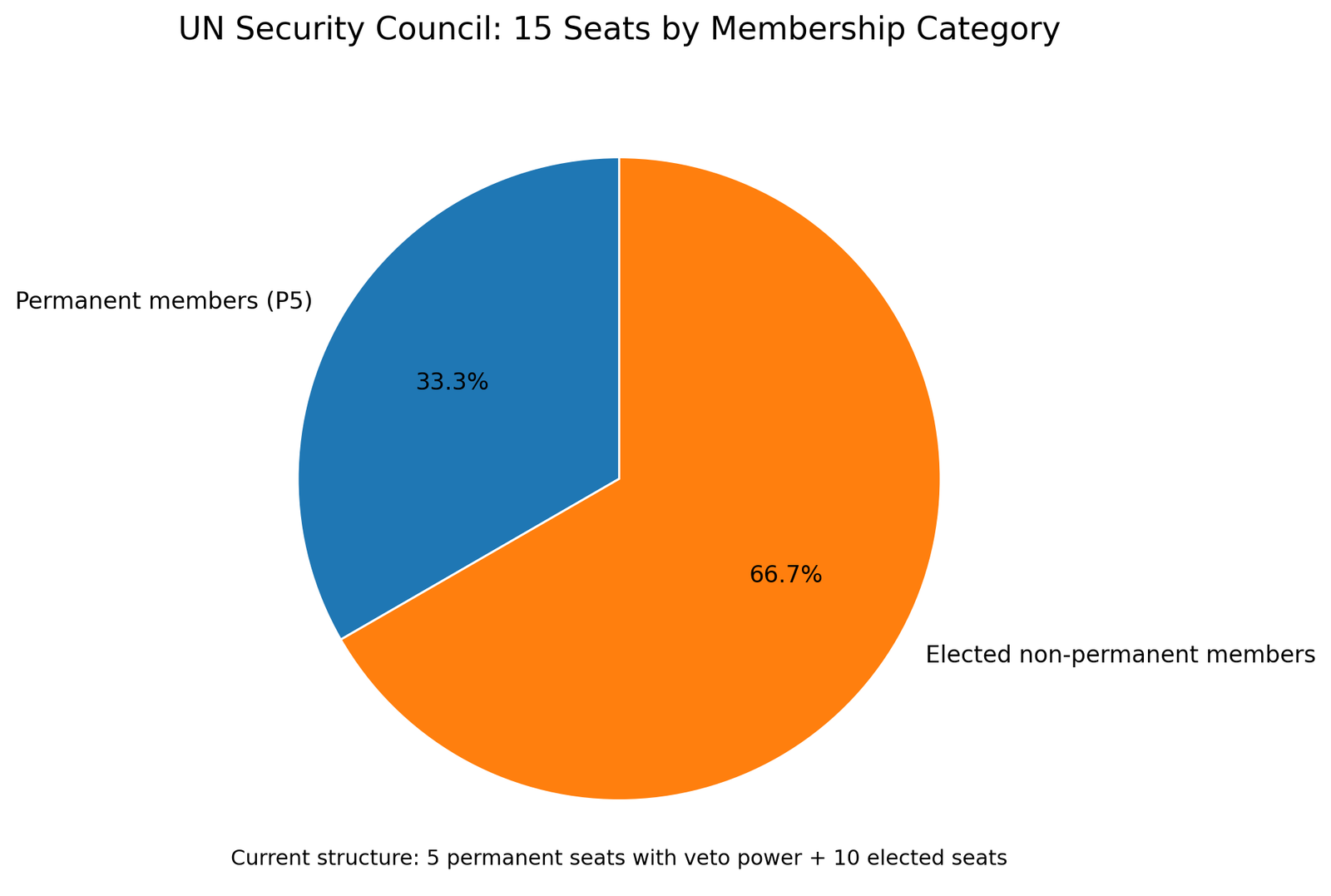
The United Nations Security Council currently consists of 15 members: five permanent members—the United States, Russia, China, France and the United Kingdom—and ten members elected by the General Assembly for two-year terms. The five permanent members possess veto power.
Africa has no permanent seat.
That institutional imbalance is at the heart of the African Union’s reform campaign.
A Council Still Structured Around 1945
The Security Council was created in a radically different international environment. Much of Africa and Asia remained under colonial rule, the Cold War had barely begun, and the distribution of global political power looked very different from today.
Eight decades later, the architecture remains largely intact.
The African Union’s common position, expressed through the Ezulwini Consensus and Sirte Declaration, calls for no fewer than two permanent seats for Africa, with all the privileges of permanent membership, including the veto for as long as the veto exists. It also calls for five additional non-permanent African seats.
The AU has maintained that Africa should not merely be consulted about decisions affecting the continent but should participate directly in making them.
That argument has become increasingly prominent as African states confront conflicts, sanctions, peacekeeping operations, humanitarian emergencies and development pressures that frequently reach the Security Council.
The Numbers Behind the Debate
The institutional imbalance can be seen immediately in the Council’s composition.


Of the Council’s 15 seats, five are permanent, representing one-third of the membership. The remaining ten are elected for two-year terms.
The question at the centre of the African campaign is therefore not simply how many seats should be added, but what kind of representation should carry institutional power.
Guterres: Reform Is “Absolutely Essential”
UN Secretary-General António Guterres has repeatedly placed Security Council reform among the most important questions facing the multilateral system.
In May 2026, Guterres argued that the current composition does not adequately reflect contemporary geopolitical realities, pointing specifically to the absence of permanent African and Latin American representation. He said increasing both permanent and non-permanent membership was “absolutely essential.”
Speaking to the Security Council later that month, he went further, describing the absence of permanent African representation as a historic injustice and arguing that it undermines the Council’s credibility and effectiveness.
The remarks are significant because they place the African demand within the broader UN debate over legitimacy, rather than treating it simply as a regional allocation dispute.
The Veto Is the Hardest Question
The most difficult issue may not be whether Africa should receive permanent seats, but whether those seats would carry the same veto authority as the existing five.
The African position is clear: if the veto continues to exist, new permanent members should receive the same rights.
The June 2026 Co-Chairs’ Elements Paper on Security Council reform records several competing positions. These include extending the veto to all new permanent members, not extending it to new members, postponing a decision through a future review, or abolishing the veto altogether. The African common position is explicitly identified among the arguments favouring equal veto rights for new permanent members.
That disagreement goes to the heart of the reform problem.
A larger Council without comparable authority for new permanent members could increase representation while leaving the existing hierarchy largely unchanged. Conversely, extending veto power to additional states could make consensus—and therefore decisive Council action—more difficult.
Neither option commands universal agreement.
Major Powers Offer Different Visions
The permanent members themselves do not share a single position on the future Council.
Russia has publicly supported expanding permanent membership while insisting that the existing veto system should remain. Kremlin spokesman Dmitry Peskov said in September that Moscow favours additional permanent members but considers preservation of the veto fundamental to the Council’s structure.
France and the United Kingdom have supported broader Security Council representation, including permanent African representation, while the question of extending veto rights to new members remains part of the wider negotiating dispute.
Russia has also recently reiterated support for India’s permanent membership and for broader representation of Asia, Africa and Latin America, while opposing some proposals involving additional Western permanent members.
China has repeatedly supported greater representation for developing countries, although the precise configuration of an enlarged Council remains subject to negotiations.
The United States’ position, meanwhile, remains an important factor because any Charter amendment ultimately requires ratification by all five existing permanent members.
The result is a diplomatic equation in which almost every major power can support the general principle of reform while disagreeing over its precise design.
The Reform Process Has Been Running for Years
The negotiations are not beginning from scratch.
The General Assembly launched the Intergovernmental Negotiations (IGN) process on Security Council reform in 2008. Since then, successive General Assembly sessions have renewed the negotiations, while member states have tabled competing models.
The process addresses five broad questions:
- The categories of membership;
- The question of veto power;
- Regional representation;
- The size and working methods of an enlarged Council;
- The relationship between the Security Council and the wider UN membership.
During 2026, the negotiations continued through a series of plenary meetings. The co-chairs circulated an African Model and later a revised Elements Paper setting out areas of convergence and divergence among member states.
The diplomatic language may appear procedural. The consequences are not.
Africa’s Argument Goes Beyond Representation
African governments increasingly connect Security Council reform with questions of development, peace and international economic governance.
The argument is straightforward: decisions on armed conflicts can affect humanitarian access, displacement, food systems, infrastructure and national development trajectories.
Peace and development are therefore not separate policy worlds.
A conflict can destroy progress toward the Sustainable Development Goals. Sanctions can affect trade and financial systems. Peacekeeping mandates can determine the international resources available to fragile states. Political decisions made in New York can therefore have consequences thousands of kilometres away.
For African policymakers, having a greater role in those decisions is part of a broader demand for greater agency within the international system.
The UN80 Initiative Adds Another Layer
The Security Council debate is unfolding alongside the UN80 Initiative, launched by the Secretary-General as an effort to make the United Nations more efficient, coherent and effective.
The initiative covers institutional efficiency, programme realignment and organisational reform. In May 2026, the Secretary-General described UN80 as entering a decisive phase in which member states would need to make political choices on structural reforms.
But UN80 and Security Council reform are not identical processes.
The UN80 Initiative is primarily concerned with how the organisation operates. Security Council reform addresses who possesses decision-making authority within the international system.
That distinction matters.
An organisation can become more efficient without necessarily becoming more representative.
A Political Problem as Much as a Legal One
Changing the Council ultimately requires more than political momentum in the General Assembly.
A Charter amendment requires adoption by a two-thirds majority of the General Assembly and ratification by two-thirds of UN member states, including all five permanent members of the Security Council.
That requirement gives the existing P5 a decisive role in determining whether structural reform can become legally binding.
It also explains why negotiations have continued for years without a final settlement.
The challenge is therefore not simply to build support among countries demanding change. Reformers must also construct a formula acceptable—or at least tolerable—to states whose institutional privileges would be affected by the outcome.
From Rhetoric to a Negotiating Text
The next phase of the debate is likely to centre on whether governments can move beyond broad declarations and begin narrowing the differences between competing reform models.
The UN’s own reform process has acknowledged the need to develop a model capable of securing the widest possible political acceptance.
For Africa, the baseline remains the Ezulwini Consensus.
For other groups, the preferred models differ—particularly over the number of new permanent members, the distribution of seats among regions, the veto and the possibility of longer-term elected seats.
The task for negotiators is therefore one of institutional design as much as diplomacy.
The Test Ahead
Africa’s campaign has placed a fundamental question before the international community:
Can an institution created to reflect the geopolitical realities of 1945 be redesigned to govern a world shaped by the realities of 2026?
There is no single answer yet.
What is clear is that the debate has moved beyond the question of whether Security Council reform is necessary. The negotiations are increasingly focused on what a reformed Council should look like, who should receive permanent representation, and whether new permanent members should possess the same powers as the existing five.
For Africa, the demand is now firmly institutionalised: at least two permanent seats, full permanent-member privileges including veto rights while the veto remains, and five additional elected seats.
For the wider UN membership, the question is whether the competing visions can be reconciled into a legally workable agreement.
And for global governance, the stakes extend beyond the Council chamber.
The outcome will help determine whether the United Nations enters its next decade with an architecture adapted to a more diverse and multipolar international system—or continues to operate with a distribution of formal power largely inherited from the world of 1945.
The debate is no longer simply about Africa’s seat at the table. It is about who the table is designed to serve.
Sources and verification
The article above has been checked against current UN and AU material, including the UN Security Council’s membership records, the UN General Assembly’s Security Council reform/IGN documentation, the 2026 Co-Chairs’ Elements Paper, the African Union’s stated common position, and recent reporting on positions expressed by major powers.
Publication note: I would use “September 30, 2026” rather than simply “September 2026” in the final AUN News edition, because it gives the article a precise reporting cut-off and makes clear which diplomatic positions were current when the article was written. un_security_council_seats_pie_chart.pngImage